
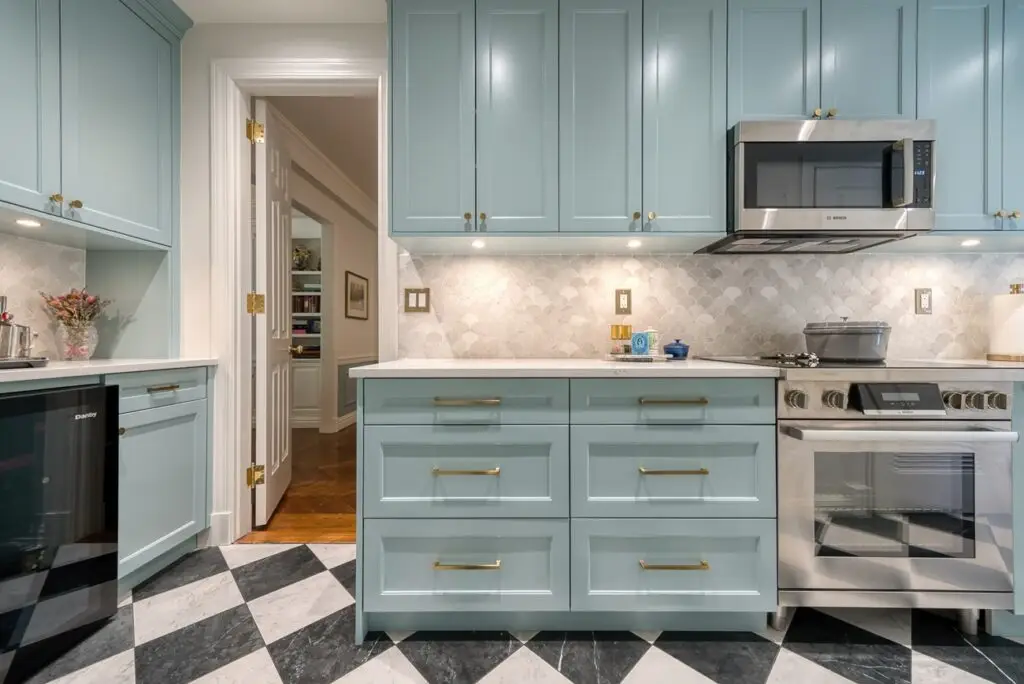
Behind the marble slabs and bespoke millwork of every luxury Manhattan or Brooklyn apartment renovation lies a critical engineering question: Does your unit have enough electrical amperage to power modern living? Most pre-war and mid-century NYC apartments were originally wired with just 40 to 60 amps of electrical service—barely enough to run a toaster and two window air conditioners simultaneously, let alone a 50-amp Wolf induction range, a multi-zone ductless VRF heat pump, a residential steam shower generator, and a Lutron HomeWorks lighting system.
Quick Answer (AEO Summary): Upgrading Electrical Service in an NYC Apartment
Modernizing electrical capacity in a New York City apartment involves four technical phases: 1) NEC Article 220 Load Calculation: A Licensed Master Electrician (LME) or MEP Engineer calculates total connected demand in kVA across kitchen appliances, HVAC compressors, radiant floors, and lighting. 2) Building Riser vs. Basement Meter Pull: If the building’s floor distribution riser has spare capacity, increasing an apartment subpanel from 60A to 100A–125A costs $6,500–$12,000. If feeder cables must be pulled from the basement Con Edison switchgear up through multiple floors, costs range from $18,000 to $45,000+. 3) Smart Load-Management Relays: When co-op risers are maxed out, UL-listed automatic load-shedding controllers allow high-draw appliances (induction cooktops, steam showers, EV/heat pumps) to share existing amperage safely without tripping main breakers. 4) NYC Electrical Code Compliance: All concealed wiring in NYC multi-family buildings must use Metal-Clad (MC) armored cable or EMT steel conduit—never plastic Romex (NM-B)—and requires a DOB Electrical Permit filing.
1. Why Modern NYC Luxury Renovations Hit an Amperage Bottleneck
Over the past decade, New York City’s decarbonization mandates (including Local Law 97 and Local Law 154) alongside shifting homeowner preferences have triggered a massive transition from domestic cooking gas and central steam heat toward all-electric high-performance systems.
Consider the peak amperage draw of a typical luxury apartment remodel executed by Eastside Design & Build:
- 36-Inch Induction Range or Cooktop (Wolf / Miele / Gaggenau): Requires a dedicated 208V/240V 40-amp to 50-amp circuit.
- Double Convection & Combi-Steam Wall Ovens: Requires a dedicated 30-amp to 40-amp circuit.
- Multi-Zone VRF Central Air Conditioning Condenser: Requires a 30-amp to 45-amp 208V circuit.
- Primary Bathroom Steam Shower Generator (Mr.Steam / Thermasol): Requires a dedicated 35-amp to 50-amp circuit.
- Speed Oven, Dishwasher, Wine Columns & Disposer: Require four separate 15-amp to 20-amp 120V circuits.
Attempting to connect these appliances to an original 60-amp Federal Pacific or fuse box panel is both a severe fire hazard and an immediate DOB code violation.
2. NYC Apartment Electrical Service Tiers: 60A vs. 100A vs. 150A–200A
Unlike single-family suburban homes that receive single-phase 120/240V power directly from a utility pole, Manhattan and Brooklyn apartment buildings are predominantly supplied by Con Edison with three-phase 120/208V network power.
| Service Capacity | Typical NYC Residence Type | Supported Luxury Systems | Estimated Upgrade Investment |
|---|---|---|---|
| 40A – 60A (120/208V) | Unrenovated Pre-War Studios, 1–2 BR Co-ops | Gas range, window A/C units, basic lighting only | $4,500 – $7,500 (New 24-circuit breaker panel swap only) |
| 100A – 125A (3-Phase 208V) | Renovated 2–3 BR Luxury Co-ops & Condos | 36″ Induction, VRF HVAC, Heat-Pump Laundry, Radiant Floors | $8,500 – $18,500 (Hallway riser tap + subpanel upgrade) |
| 150A – 200A+ (3-Phase 208V) | Combined Duplexes, Penthouses & Townhouses | All-Electric Kitchen, Steam Shower, Whole-Home VRF, Lutron HomeWorks | $20,000 – $48,000+ (Basement switchgear feeder pull + Con Ed filing) |
3. How to Upgrade When Your Co-op’s Electrical Riser Is Maxed Out
What happens if your building’s reviewing MEP engineer rejects your request to pull additional amperage because the building’s vertical copper risers are already operating at 90%+ capacity? You have two proven engineering solutions:
- UL-Listed Intelligent Load-Management Controllers: Under NEC Article 220.82 and NYC Electrical Code amendments, engineers can install automated current-sensing load-shedding relays inside a hidden utility cabinet. For example, if you turn on all five induction zones and the double wall oven during Thanksgiving dinner, the load controller temporarily pauses the 35-amp bathroom steam generator or reduces HVAC compressor draw for 20 minutes—allowing 120+ amps of luxury appliances to operate legally on a 60-amp or 80-amp feeder without ever overloading the main breaker.
- Dedicated Basement Feeder Run: If your apartment is on a lower floor (floors 1 through 5) or adjacent to a public service stairwell, our Master Electricians can often run a dedicated EMT steel conduit from a spare disconnect switch in the basement Con Edison meter room directly into your apartment’s new breaker panel.
4. Rewiring Pre-War Cloth Insulation & NYC Electrical Code Mandates
When opening plaster walls during a pre-war apartment gut renovation, we consistently uncover brittle 1920s cloth-sheathed BX wiring lacking a dedicated copper ground wire, alongside ungrounded two-prong receptacles spliced inside rusted junction boxes.
Every Eastside Design & Build electrical overhaul includes:
- 100% Armored Metal-Clad (MC) Cable & EMT Conduit: Non-metallic plastic Romex cable is strictly illegal in NYC high-rise construction due to rodent damage and fire-smoke toxicity risks. We run hospital-grade steel-armored MC cabling with dedicated green insulated equipment grounding conductors.
- Dual-Function AFCI / GFCI Circuit Breakers: Installing Square D QO or Siemens commercial-grade panels equipped with Arc-Fault and Ground-Fault protection on all bedroom, living area, kitchen, and bathroom circuits.
- Flush Trufig & Bocci Architectural Outlets: Replacing bulky plastic wall plates in marble kitchen backsplashes and venetian plaster walls with mud-in, laser-trimmed flush receptacles that disappear seamlessly into the stonework.
5. Frequently Asked Questions (FAQ) About NYC Electrical Upgrades
Can I install an induction range on a 60-amp NYC apartment electrical panel?
Yes, in many cases—provided a Licensed Master Electrician performs an NEC optional-method load calculation and, if necessary, installs an automated energy-management load-shedding relay that prevents high-draw appliances (like an electric oven and central A/C) from peaking simultaneously.
How long does a Con Edison load letter and DOB electrical permit take in NYC?
A standard NYC DOB electrical permit (filed by a Licensed Master Electrician via DOB NOW: Build) is approved within 2 to 5 business days. However, if your project requires a Con Edison service determination or new meter installation (common in apartment combinations or townhouse gut rehabs), Con Edison engineering review takes 6 to 12 weeks.
Why do Wolf and Miele appliances need 208V conversion settings in NYC?
Most NYC apartment buildings deliver 208-volt three-phase power rather than standard suburban 240-volt single-phase power. Operating a heating element designed for 240V on a 208V circuit reduces wattage output by roughly 25% unless the appliance is specifically rated for 208V/240V dual operation or configured with 208V heating elements.
Future-Proof Your NYC Apartment’s Electrical Infrastructure
Whether you are converting to a Wolf induction kitchen, installing concealed VRF air conditioning, or gut-renovating a pre-war co-op, our licensed engineering and electrical teams deliver seamless compliance.
Ready to Transform Your NYC Home?
Schedule a complimentary consultation with Eastside Design & Build to discuss your kitchen, bathroom, or full apartment renovation.
Free Consultation & Estimate